The Sun keeps us warm and provides perfect conditions for life on Earth. It also keeps all the planets and smaller debris in its orbit, holding the Solar System together. But how much more do you know about it?
Below I’ve gathered 10 interesting facts about the Sun!
1. The Sun is a G-type main-sequence star, informally called a yellow dwarf
Stars are born from collapsing clouds of gas and dust. Once they become hot and dense enough in their cores, hydrogen fusion begins, and the star enters its main sequence phase. Stars spend most of their lives in this phase, and once the hydrogen fuel is exhausted, further stellar evolution follows.
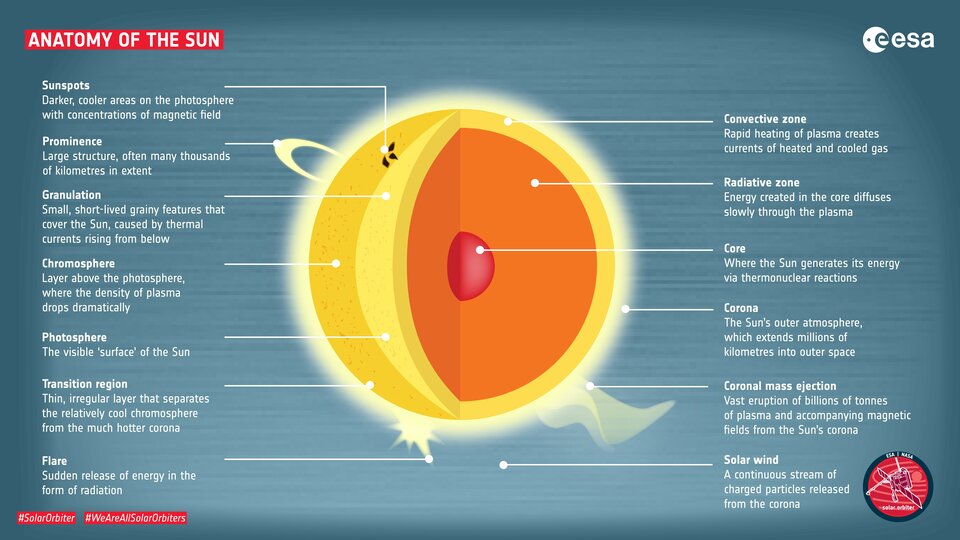
There are seven types of main-sequence stars, often referred to as dwarf stars. Our Sun is a G-type main-sequence star, also called a yellow dwarf. It converts the element hydrogen into helium in its core through nuclear fusion. Each second, the Sun fuses approximately 600 million tons of hydrogen into helium, converting about 4 million tons of matter into energy.
2. The Sun is actually white
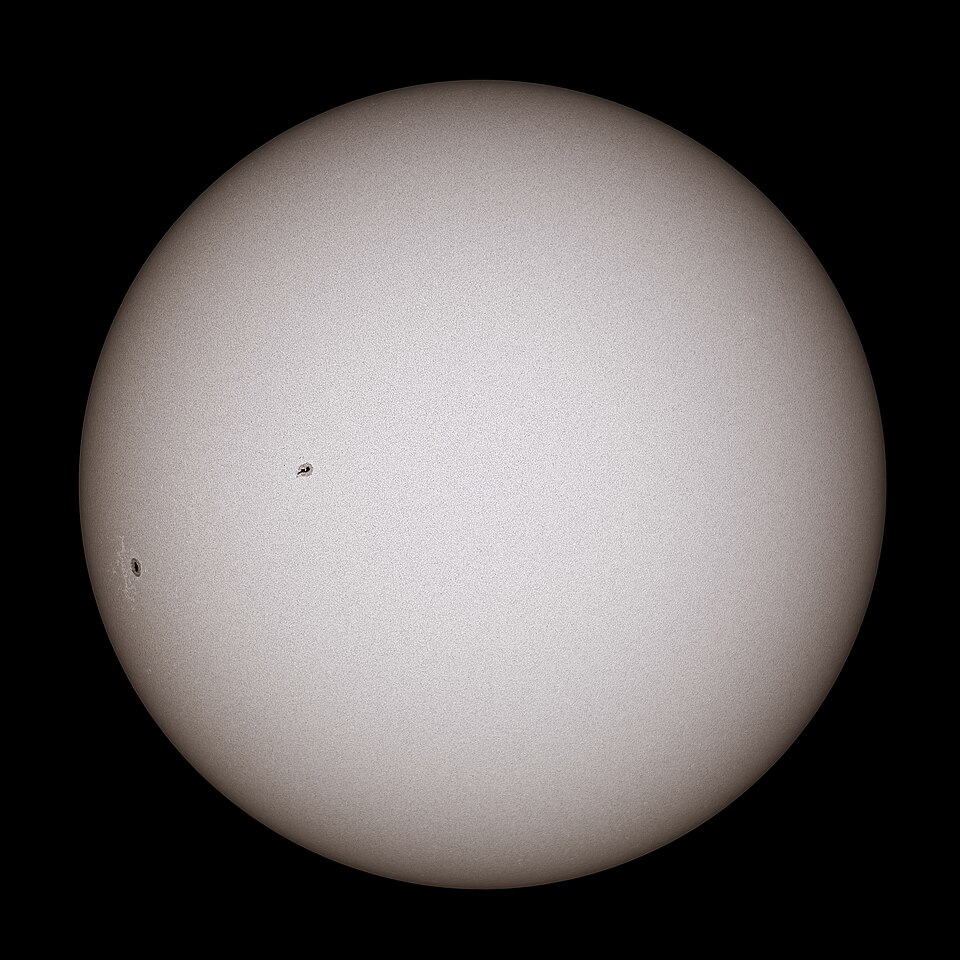
This might come as a surprise, but the Sun’s true color is actually white. Even though G-type main-sequence stars are called yellow dwarfs, this term is a misnomer. G-type stars actually range in color from white, such as our Sun, to only very slightly yellowish for less massive and luminous G-type main-sequence stars.
The Sun emits all colors of the visible spectrum, but Earth’s atmosphere scatters blue light, making it appear yellow, orange or red, especially at sunrise and sunset. At noon, when the Sun us high in the sky and less atmosphere filters the light, it appears whitish-yellow. For an astronaut in space, without Earth’s atmosphere to interfere, the Sun looks completely white.
3. The Sun’s core temperature is 15 million °C
I think we all know the Sun is really hot, but dо you know how hot it actually is? The core temperature is the unimaginable 15 million °C!
The temperature of the Sun’s surface, called photosphere, is only 5,550°C, though, while the Sun’s corona, the outermost layer of the star, is 1 million °C. Scientists still can’t figure out exactly why there’s a difference in the temperature between the corona and the surface and how the corona is so much hotter, even though it extends millions of kilometres beyond the surface.
4. The Sun is 8 light-minutes away from Earth
The distance between the Sun and Earth is about 149 600 000 km. In shorter words – 8 light-minutes. This means that it takes 8 minutes (and 19 seconds) for the Sun’s light to reach our planet. If, for some funny reason, the Sun suddenly stops emitting light or disappears, it’ll take 8 minutes until we notice something is amiss.
The speed of light is a constant – it never speeds up, it never slows down. For that reason, scientists measure the vast distances in space by the time it takes light to travel the distance. If we say a certain cosmic object is 120 million light-years away from us, it means it’ll take 120 million years for light, or a spacecraft traveling at the speed of light, to cover the distance between Earth and that cosmic object.
5. The Sun rotates faster at its equator than at its poles
The Sun is not a solid body. Rather, it’s composed of gaseous plasma and different latitudes rotate with different periods. This is caused by convective motion (cyclical movement within fluids – liquids and gases, or soft solids, driven by density differences) due to heat transport and the Coriolis force (a pseudo force that acts on objects in motion within a frame of reference that rotates with respect to an inertial frame) due to the Sun’s rotation.
The rotation at the equator is approximately 25.6 days. This period increases further from the equator and closer to the poles, where rotation takes about 33.5 days.
6. The Sun is about 4.6 billion years old and will live as we know it for about 5 billion more
The Solar System began forming about 4.6 billion years ago with the gravitational collapse of a small part of a giant molecular cloud, consisting mostly of hydrogen and helium. Most of the collapsing mass collected in the center, forming our Sun. The rest turned into a protoplanetary disk and eventually all the planets, moons, asteroids, and other small bodies within the Solar System formed.
It is estimated that our star has about 5 billion years left before it runs out of hydrogen. The fusion will then cease and the Sun will no longer be in hydrostatic equilibrium. It’ll cause expansion over the next billion years and increased luminosity. Eventually, the Sun will become a red giant, engulfing (and destroying) Mercury and Venus. It is believed that Earth will suffer the same fate, as well, about 7.59 billion years from now.
7. The Sun’s magnetic field flips every 11 years
Just like our planet, the Sun also has a magnetic field with a north and south pole. The source of this field is the constant movement of electrically charged particles within the Sun. Every around 11 years, the two poles switch places with north becoming south and south becoming north. This periodic change is called solar cycle.
The reshaping of the Sun’s magnetic field is accompanied by massive amounts of energy and streams of charged particles send out into space – solar flares and CMEs. Solar flares occur when the magnetic energy stored in the active regions is suddenly released. At other times, the Sun sends out large amounts of solar material in the form of coronal mass ejections (CMEs).
8. It takes the Solar System about 225–250 million years to complete one orbit through the Milky Way
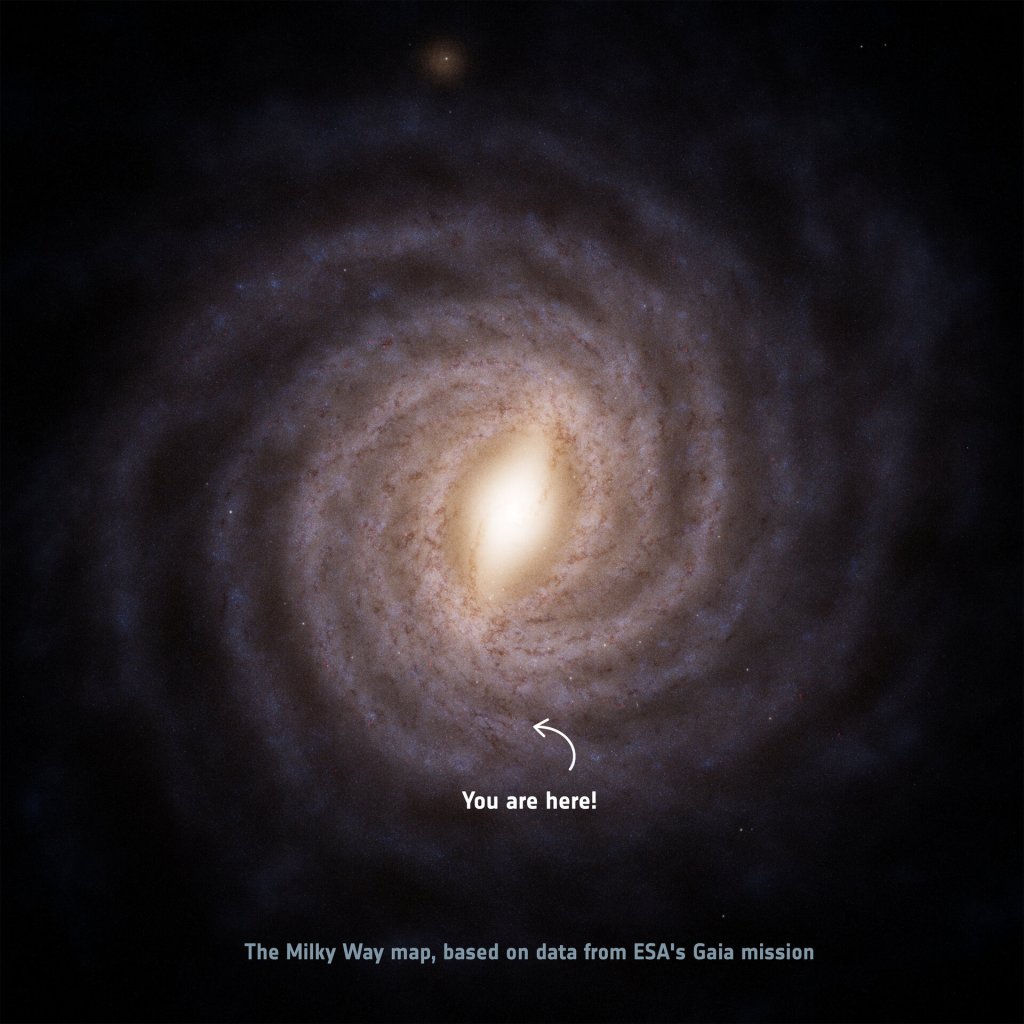
Our galaxy, the Milky Way, is a spiral galaxy and is in constant motion not only through space, but also about its own axis. All the cosmic objects within it are also following this motion, orbiting around the galaxy’s core called Galactic Centre.
It takes the Solar System about 225-250 million years to complete one orbit around it. It is believed that since the birth of our star, it has completed 20-25 orbits. The orbital speed of the Solar System about the centre of the Milky Way is approximately 251 km/s. At this speed, it takes around 1,190 years for the Solar System to travel a distance of 1 light-year.
To help you better picture this: The dinasaurs saw a different night sky than we do today. Not only due to the Solar System’s everchanging position within the Milky Way, but also due to all stars’ own motion. So, if an astronomer was to somehow teleport themselves during the Mesozoic Era, for example, they would observe a completely different night sky.
9. The Sun has “freckles” called sunspots
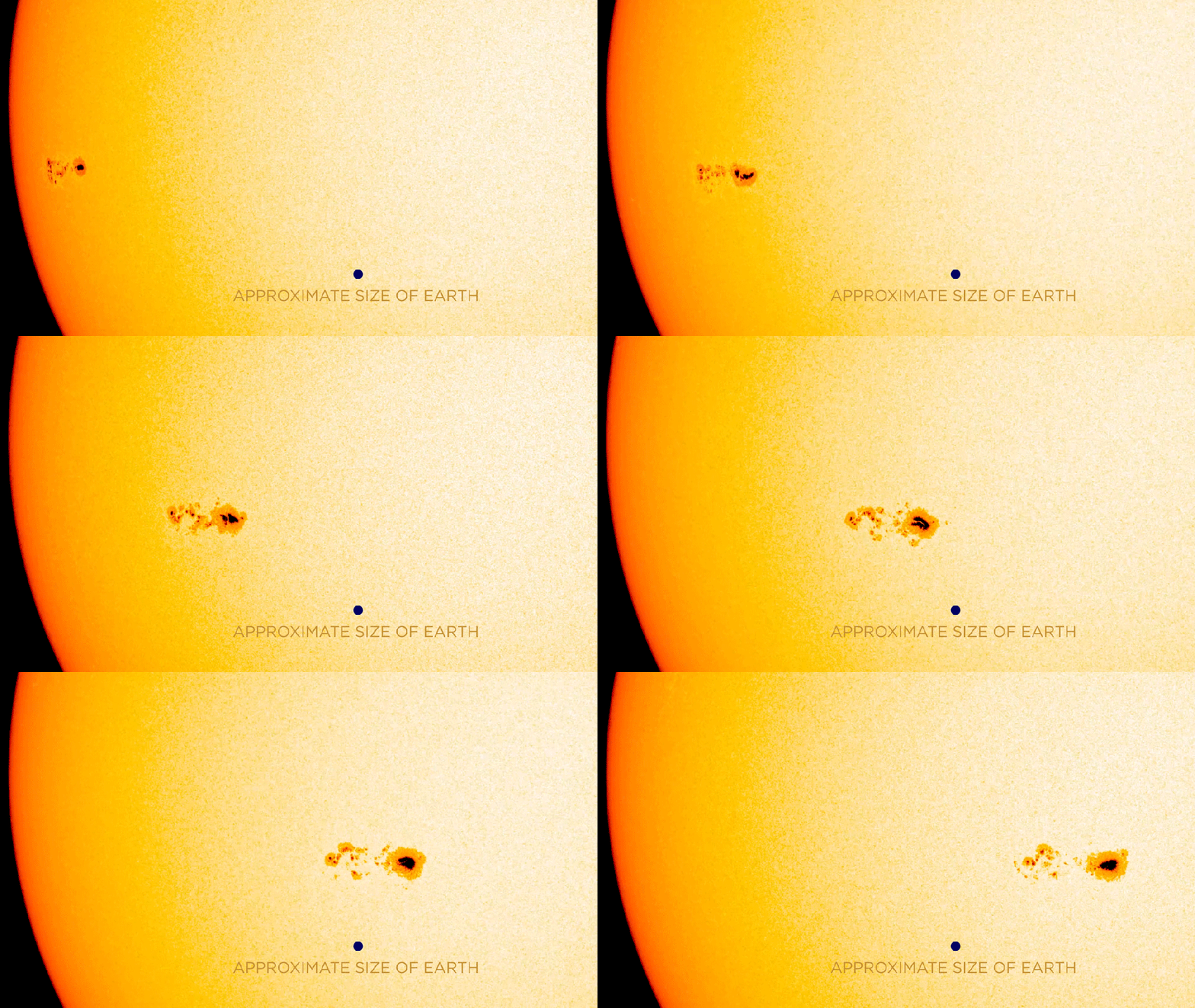
Occasionally, dark spots appear on the face of the Sun. They’re called sunspots and represent cooler areas on the Sun caused by a concentration of magnetic field lines. Due to the lower temperature compared to the rest of the Sun’s surface, they appear darker.
Sunspots can last between a few days and a few months and stretch thousands of kilometers across. The largest sunspot was measured in 1947 and it was 35 times Earth’s area. Many solar outbursts (solar flares and CMEs) come from areas with sunspots, also called active regions.
10. The Sun is constantly getting hotter and bigger in diameter
The Sun is gradually becoming hotter, larger in radius, and more luminous during its time in the main sequence phase. This is caused by the fusion of hydrogen into helium in the Sun’s core. With time, the core becomes denser and hotter, increasing the fusion rate and, consequently, its energy output (luminosity). This process makes the Sun slowly get brighter, emitting more light and heat over billions of years.
Since its formation, the Sun has expanded in radius by 15% and is 48% more luminous. At present, it is increasing in brightness by about 1% every 100 million years. This process will inevitably make life on Earth impossible. In about 1 billion years, the Sun will be so bright it’ll cause depletion of liquid water on our planet. Earth will cease to be able to support complex, multicellular life, which will result in a final complete mass extinction (assuming there’d still be any life here by then).
For now, the Sun provides us with the perfect conditions for supporting said multicellular life, so let’s enjoy it while we have it! And I hope you also enjoyed reading this article and learned something new!
Till the next time!
Lina Dimitrova
06/01/2026
The Sun | Mercury |





 Rings of Saturn Blog