Hello there wanderer! You have landed upon the very first post on my blog! Welcome! I am most excited to greet you here and share with you some thoughts and interesting facts.
As you can already see I named my blog after The Rings of Saturn!
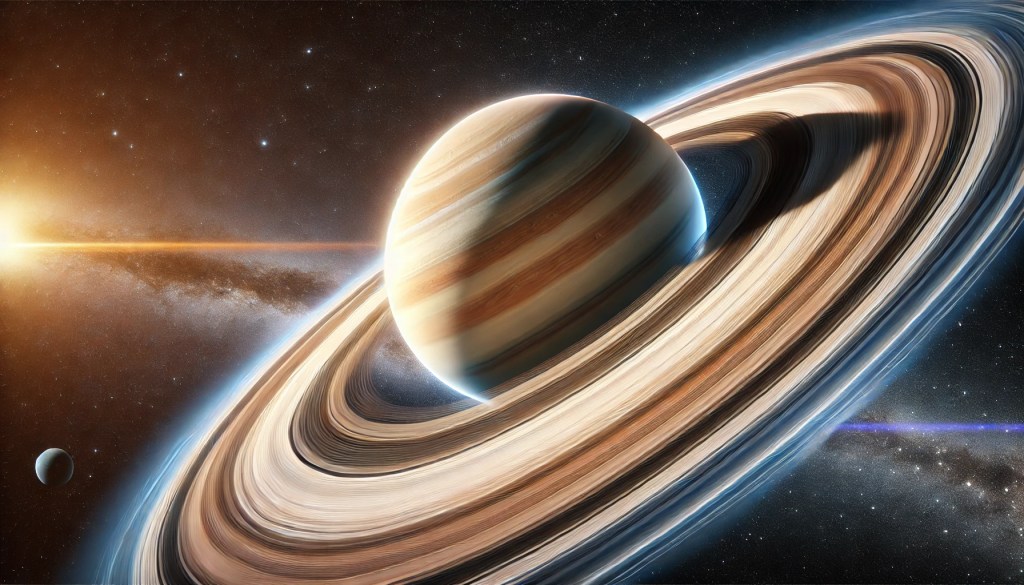
So, I thought that, as a beginning, I should say a few words of why I decided to start a blog, how I came up with the name and, of course, some words of what those ‘rings’ are.
Let’s begin, shall we?
‘Why?’ as in ‘Why did I decide to launch a blog?‘
Stuck in my previous job as a Content Editor for an online store, I was very close to resenting my life. I had long exhausted my capabilities in that company and I was in a desperate need of a change (especially approaching the age of 30!!!). I had been working there for five and a half years, and the latest shifts in the workflow only made it more dreadful for me and my teammates. We all began making plans for salvation (it quite literally felt that way). I had long dreamt of giving the freelancing a try, so I told myself ‘it’s now or never’! (Yeah, yeah, I know, a bit overdramatic, but sometimes one needs a dramatic push to help them go forwards)
While thinking of all the possibilities in front of me, I somehow came up with the idea of running a blog. I’ve always loved writing, but I was often too busy to pursue this hobby of mine. ‘Enough is enough,’ I said and decided I should develop it more, so I signed up for a copywriting course and started working on my own website.
‘How?’ as in ‘How did I name my blog ‘Rings of Saturn’?‘
Okay, so the decision to start a blog came very easily. Coming up with a title proved to be quite challenging.
I really didn’t know what a proper title would be. I had already decided my blog would be diverse in general. I am fascinated by the Universe, I’m interested in science, I love hiking and spending time in the nature, I love traveling and exploring our world, I love baking, cooking, watching movies & shows, reading books, and many other hobbies. There are a lot of things one could say about a whole lot of topics, so I tried to come up with a name that could possibly address everything.
After scratching off numerous possible titles I decided this approach is a bit blunt or at least it didn’t suit me. So, my thoughts wandered towards my different interests and random facts about me. Such as my zodiac sign – Capricorn! I wouldn’t say I’m the biggest believer in astrology, but nonetheless, I already knew that Capricorn’s planet is considered to be Saturn. And from that thought naturally came the idea ‘Rings of Saturn’! So, here we are today!

‘What?’ as in ‘What are The Rings of Saturn?‘
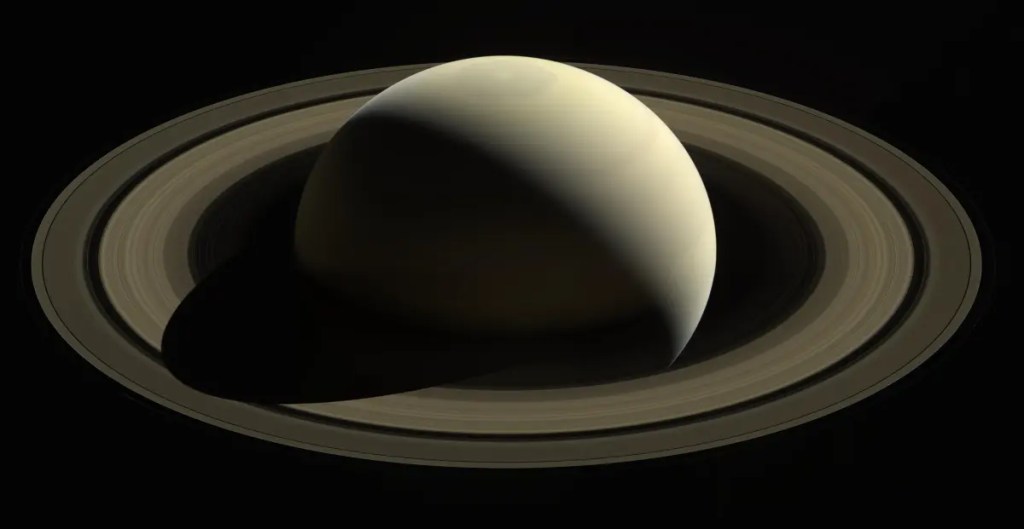
As a beginning, the ‘rings’ surrounding a certain astronomical object are called ring systems. A ring system is composed of solid material such as dust, meteoroids, planetoids (minor planets), moonlets (small natural satellites orbiting a planet) or stellar objects. Ring systems form for various reasons, but most likely they’re small stellar objects which get pulled and torn by the gravity of a large planetary object (ouch), creating a chain of debris around it. They spin due to the planet’s tidal force which is why they look like actual rings to the side observers.
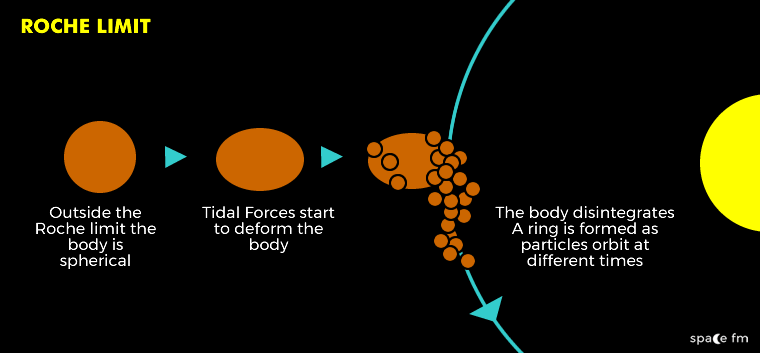
This invisible ‘boundary’ is called the Roche limit, also the Roche radius, and it refers to the distance at which a large object is so close to a planet that the planet’s tidal force pulls it apart. And yes, you guessed it – it is named after the scientist who first calculated this theoretical limit, the French astronomer Édouard Roche.
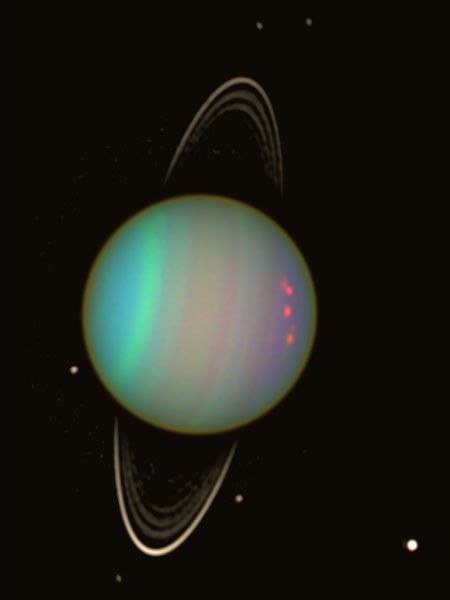
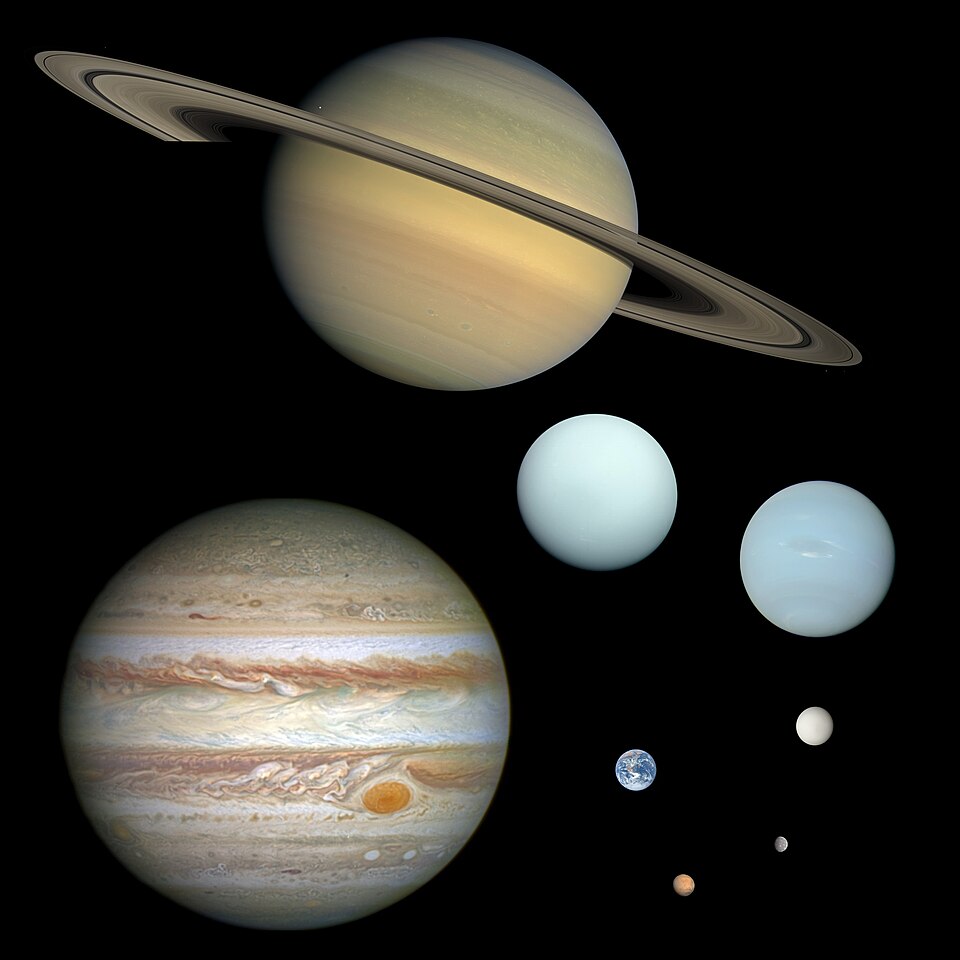
Saturn’s ring system is the most extensive and complex among the planets in the Solar System. As a matter of fact, did you know that Jupiter, Uranus (could never not laugh at that name, I’m so sorry dear Uranus) and Neptune also have ring systems? However, they’re much fainter and thinner and not as spectacular, so people seldom talk about them.
Saturn’s rings consist almost entirely of water ice, with a trace component of rocky material. The size of the particles varies from smaller than a grain of sand to as large as mountains. Scientists don’t have a definitive answer as to what event led to their formation. The most recent theory suggests that the ring system formed after the collision of two moons some hundred million years ago.
Also, there isn’t a definitive answer as to the ring system’s age. The estimates vary depending on the used approach. Some believe the rings formed around the time Saturn itself did. However, there’s data from NASA’s Cassini spacecraft suggesting that the rings formed within the last 100 million years. In other words – they’re really old! But also not immortal. Just like everything else in the Universe (and perhaps the Universe itself) Saturn’s rings are expected to disappear one day – presumably in about 300 million years. So, don’t worry, we still have plenty of time to observe them.
In that note, the first person to have ever observed Saturn’s rings was none other than Galileo Galilei himself. In 1610, he used his self-built telescope to explore the fascinating planet. However, at that time, he wasn’t able to identify the rings as such. He believed that Saturn was composed of three parts and even referred to them as Saturn’s ‘ears’.
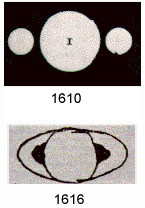
Two years later, the Earth passed through the plane of the rings making them invisible. Galileo was mystified as to what had happened to the planet and its ‘ears’. He wondered if perhaps Saturn had ‘swallowed his children’. Thеse words referred to the myth of the Titan Saturn who devoured his offspring to forestall the prophesy of them overthrowing him.
The image below gives a visual example of the mentioned ‘disappearing’.
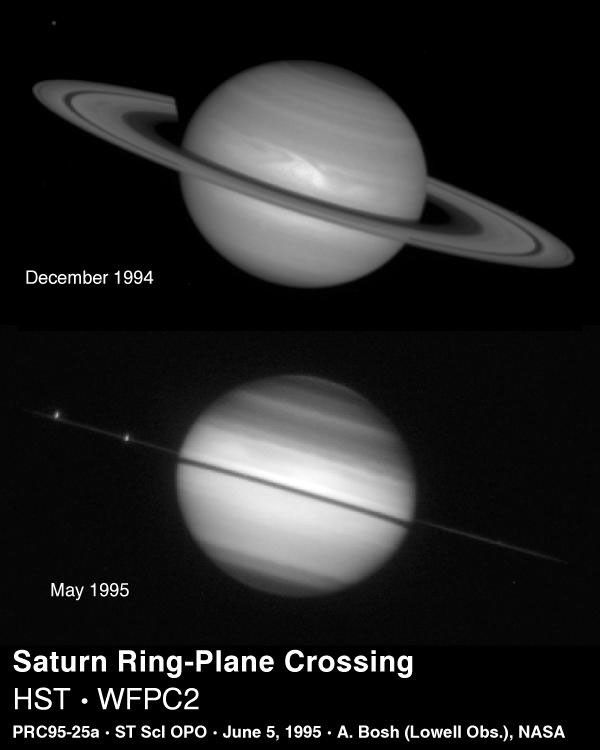
In 1613, the rings ‘reappeared’ confusing Galileo even further. I guess, in today’s terminology, we could say he got bamboozled, right?
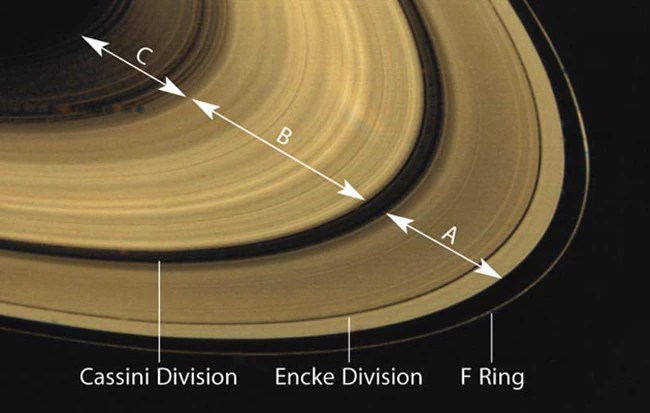
It was years later when other observers started theorizing that Saturn’s bizarre appearance was due to a ring surrounding it. Christiaan Huygens was the first to suggest that Saturn was surrounded by a ring actually detached from the planet. Twenty years later, in 1675, Giovanni Domenico Cassini determined that Saturn’s ring was actually rings and that there were gaps between them. The rings are named alphabetically in the order of their discovery. The largest gap is between A Ring and B Ring spanning 4800 km (about 3000 miles) in width! It was discovered by Cassini himself and, therefore, was named the Cassini Division.
Saturn is undoubtedly a unique planet which continues to fascinate astronomers and fanciers (such as myself) with its mesmerizing ring system. It’s fair to say that once I came up with that name everything else just fell into place.
And if you’ve reached this far, I warmly thank you for reading! This is just the beginning of what I hope to be a long-running blog sharing lots of interesting, educational, entertaining, and captivating content!
Till the next time!
Lina Dimitrova
17/06/2025





 Rings of Saturn Blog